
What people expect from a Trappist brewery tour in Belgium (and what they actually experience)

If you’ve ever Googled “Trappist brewery tour Belgium”, you’ve probably seen the same promise dressed up in different words: step behind monastery walls, see monks at work, witness the secret craft.
Here’s the honest truth: a Trappist-themed day in Belgium is rarely about watching monks brew beer in silence.
It’s about heritage. Tradition. The changing role of monasteries in modern society. And the quiet, powerful feeling of standing near places that shaped the world’s most respected beer culture - even when the doors stay closed. Which... is part of Trappist culture.
A great Belgian beer experience with a private guide doesn’t try to “force access.” It turns what you can see into something you’ll actually understand.
Now let's clarify some things as we dive into a world of monks, of guides, and of travelers.

What “Trappist” actually means (and why it matters)
Let’s clear up the label first.
Trappists are monks of the Cistercian Order of the Strict Observance. They have their origins in Northern France, from the abbey of La Grande Trappe - the one that recently got shut down. History forced them to flee across the world, but quite a few settled down in Belgium.
Their lives are built around prayer, community, and work - and that work can take many forms. Across history (and still today), monasteries have produced all kinds of goods: cheese, bread, candles, soap, farming products, and yes - beer.
The beers are known for setting a lot of our standards and expectations of taste. Their soap... not so much.
When it comes to beer, you’ll often see the Authentic Trappist Product (ATP) label. That label exists to protect meaning, not marketing.
In simple terms, ATP rules focus on:
The product being made within a monastic setting
The monastery owning or overseeing production
Profits supporting the monastic community and charitable causes
And here’s the key detail most packaged tours ignore: the rules allow for breweries to be owned or overseen by monks without the monks physically brewing every batch themselves. Modern production realities, staffing, and scale have changed what “monastery beer” looks like.
On top of that, the Trappist world is shrinking. Communities are getting smaller - and some places have recently changed status or closed entirely (like Zundert and Achel).
All of this means one thing for travelers: a purely Trappist-only itinerary can be surprisingly limited in what you can realistically visit.
So if your dream is “see the monks stir in a copper kettle as they whisper a prayer into the barley for higher quality” the experience can feel underwhelming - unless it’s framed the right way.
What you’ll actually experience on a Trappist-themed tour in Belgium
A real-world brewery tour Belgium day that focuses on Trappist heritage as packaged, usually is a different experience.

A driver brings you to the terrain of the monastery, which you'll see from the outside - from a distance. Then you go to a tasting room or visitor center, where you enjoy a simple beer tasting (and some cheese, if you're lucky). Then you go to the tourist shop where you can buy some beer and cheese, or the soap and candles.
If you're lucky, the driver tells you some stories about the order, like their origins and rules.
And as you take a stroll on-site, you enjoy the silence and atmosphere that surrounds these holy places - leaving some room to reflect.
Those strolls also help to stretch your legs - as the Trappist monasteries are strewn pretty far apart through the countryside, meaning you'll spend quite a bit of time inside a car.
That last one surprises people: Belgium is small, but Trappist sites aren’t “next door” to each other. A Belgium monastery tour can involve long drives - and that can be either a downside… or the perfect space for stories, context, and anticipation.
Often, the trip leads you across borders, as La Trappe (also known as Koningshoeven) is a Dutch Trappist monastery. This is actually one of the most commercial ones, where you CAN book a tour of the brewery's inside.
Westmalle also has a brewery tour - one weekend per year. Imagine planning your entire Belgian trip around coming to that specific event, and then not getting the tickets (they sell out within minutes).
Case study: when expectations break - and storytelling saves the day
A recent private tour request showed me how fragile these expectations can be, and how powerful good storytelling can be if access is limited.
One day I got the kind of phone call every tour guide dreads: "Hey, I have these guests who want to see the Trappist monks TOMORROW, can you arrange this for them?"
I swallowed - not because there was a Trappist beer in my mouth, but because I know such requests can carry misunderstanding.
But, professionalism must prevail. "Yes, happy to provide that if I reassign some guides. What are they looking for?" And that is when the bomb hit. "Not much. Just some monks, seeing the breweries and trying some beer. About 10 hours".
Not much. "Just" some monks.
My mind started running simulations, going over options. Quickly checked opening hours. Created a mental map and travel times. There were possibilities, sure. But I also had to be blunt.
"Sir, I can provide a tour to some trappist monasteries... but we won't be seeing monks." Silence from the other side.
"But... I promised them".
I explained what I could do and couldn't do, and out of options - the tour was booked.
Next day I picked up the guests at their hotel in Antwerp - friendly people. First order of the day was welcoming them, and telling them what the day would look like.
They smiled all the way... until the end of my summary. "Wait, so we won't be seeing the inside of a brewery? We won't see the monks work?"
I understood their shock, as I felt the same in that very moment. These people were promised a brewery tour in a monastery. Leisurely strolling through the buildings, sitting around for a while, enjoying stories in a museum setting.
This creates 2 challenges for a tour guide:
You now have to actively reshape expectations so they can be met with reality
You have to make clear that the "active" part of the day will be shorter, and the driving part will be longer.
So we rebuilt the day fast - without breaking the theme.

First, I arranged a last-minute visit to a non-Trappist monastery. How last minute? I called right after I had welcomed the people inside my car, to join for a tour in 20 minutes, for which we arrived with seconds to spare.
Not because it was “close enough,” but because it gave the guests something they were craving: a real connection to the technical craft and more interactive section for the day.
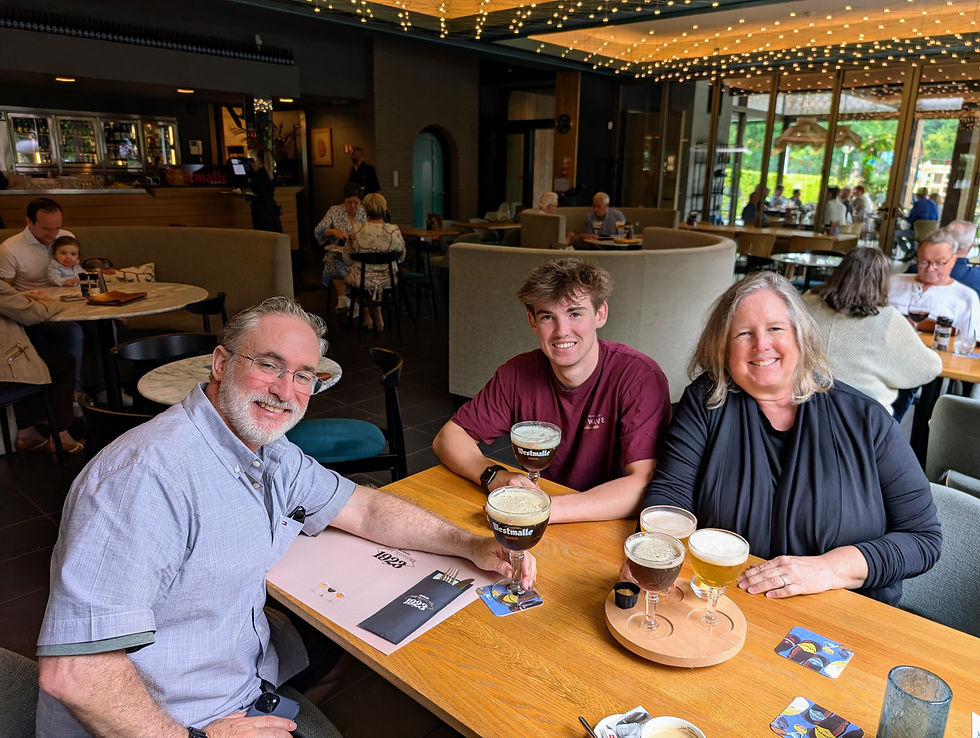
Then we went to the Trappist bar at Westmalle - the kind of stop that looks simple on paper, but becomes unforgettable when you know what you’re tasting and why it exists. The guests enjoyed a tasting on the terrace with the monastery and its cows in view, while I told about the history of the place. And because the place has delicious cheese, they had lunch there as well.
Then we jumped across the border (though this jump was a rather long drive, as there was no Trappist monastery closer nearby). This monastery allowed for a bit of a closer walk, had a small shop with religious products - and a bigger visitor center. We strolled through the gardens while discussing how Catholic monks end up in the Protestant Netherlands.
Here’s what changed everything: instead of selling access we couldn’t deliver, we delivered meaning.
We talked about origins. Monastic rules. The tension between silence and industry. How monasteries were shaped by the beer world - and how they helped shape it in return.
By the end of the day, the guests didn’t feel like they “missed the real thing.” They felt like they finally understood it.
Why storytelling is the real “VIP access”

We drove back to Antwerp - the guests having their bellies full of great beers, their heads filled with stories, and a heart full of memories.
And on the way to my own home, I reflected on something that almost slipped my mind.
This is the part most people don’t realize until they’ve done both a generic tour and a great private one.
Guests don’t buy buildings - they buy meaning and memories
Access is secondary to interpretation; seeing every stone doesn’t automatically create understanding
A guide is a translator: turning “history” and “buildings” into a culture you can understand and participate in
That’s what makes a private beer tour, or any other Belgian tour experience different. You’re not collecting stops. You’re collecting insight.
That's why we build our tour designs from the ground up, rather than from a copied template.
Why most Trappist tours dissappoint
Packaged tours often rely on a fixed promise: this is what you’ll see.
But Trappist heritage doesn’t always work like that. Travel itself doesn't always work like that.
And that's something we as professionals need to communicate clearly - as we strife for authenticity and not just the next sell.
Especially in times where AI is used to create schedules and slap pretty images or visually represented schedules on them.
As private guides and tour designers on the ground, we have a few opportunities that those selling the tours can't produce.
We can offer flexibility when reality differs from expectations - and aren't afraid to show that. We can't afford not to, really. We are the ones facing the traveler, to see their dissappointment when promises aren't kept or doors remain locked. Honesty is our biggest product.
The ability to pivot - our experiences traveling around with guests have shown us the real cost of travel. Energy. Time. Transition. What might look like 20 minutes on a schedule, could easily become 30 or 40. Places that seem open online might be closed on that specific day.
Stops chosen for story and atmosphere, not just “tick-box” branding - when a label like "Trappist" is put on a tour, it limits the scope of what we can do without stepping outside those lines. Even when the addition of another stop that doesn't necessarily adhere to the promised label might still create a wonderful experience and support the main story, once a promise has been made (even if it wasn't us) - the dream has been created. Breaking that always affects the energy.
A day built around your pace, interests, and comfort - knowing the real time and energy cost, we optimalise for the total experience. Visiting three monasteries in a day might sounds cool on a travel blog - but that illusion vanishes if you spend 5 hours inside a car of your 10-hour day.
Rather we create clusters of storytelling, shorter arcs and trips. You get tired? We create extra rest. You're excited? We speed up.
In other words: even when the doors are closed, the experience doesn’t collapse.
A guide doesn't need to open doors to create a great day - we do so by explaining why the closed door matters in the story.
Where we are now: Trappist heritage tours, done honestly (and better)
I learned a lot that day. First of all, we got more selective about who we run tours for. Do they sell a real approach to what Belgian travel looks like? Do they promise before they research? And do they allow us to assist and design a product that is useful?
That's why now we offer Trappist heritage tours that are built for reality - not fantasy.
We focus on telling the story of the Trappist monks and their heritage through stops that make sense. Not in the most narrow way, but in a layered context: other breweries, monasteries and cities help us to understand the world that shaped these monks and show us what influences on our society they left behind.

It frees up logistics, meaning we can implement room to breathe and rest - or actually interact with the history and culture of this land.
Now you can enjoy a variety of activities, instead of just seeing three tasting rooms with slightly different architecture - while still enjoying beer in a culturally rich environment.
You still get to live through the main theme of Trappists - but without the limits that can turn a day into a disappointment.
And we can put all of our energy into sharing our carefully crafted tales and insights with you, instead of fretting about traffic or checking all of the boxes on the list.
You're still booking the "story of the Trappist monks" - but not simply a "Trappist tour".
Ready to plan your own Trappist-themed day?
If you want a Trappist brewery tour in Belgium that feels premium, personal, and meaningful, you’ve got a few easy options.
Get inspired via our Full-Day Excursions section - and tell us you want Trappists included as a key interest (plus any must-sees you want guaranteed)
Or simply email us (beardbarianentertainment@outlook.com) and tell us what you’re dreaming of
Prefer a quick chat first? Book a call - and get the cost of the call back as credit for your tour.
Within 48 hours, you’ll receive a customized itinerary offer we can build on together - so your day feels seamless, story-rich, and genuinely unforgettable.
Because the best Belgian beer experiences aren’t about sneaking behind walls.They’re about understanding what those walls were built to protect in the first place.


Comments